

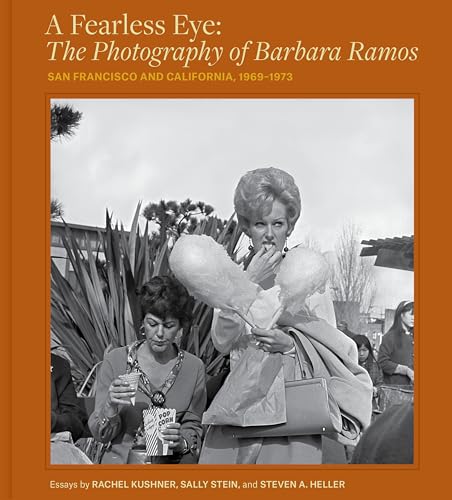
I have such an affinity for photography. I especially like the grittiness and rawness that one can get with black and white photography. When I saw that these photos were from the 1970’s in California (mostly San Francisco), I really wanted to take a look.
The book opens with three essays – one each by Rachel Kushner, Sally Stein, and Steven A. Heller. These are all a little disappointing. While they touch lightly on the works and photographer Barbara Ramos, they lean heavier on reflections of place and time – memories brought about seeing the work.
But this is the problem with the book in general. Other than what we see, we get no background on the works. If I were walking in a gallery to look at these photos, I wouldn’t be looking for anything other than what the photos bring to mind. But in a book I want more clarity. What caught the photographer’s eye that she took the photo of the people waiting for the bus at Nob Hill? “Couple with Baby” doesn’t look at all like a couple to me – why name it this? How does Ramos know it’s a couple? Why did she think to take this photo? (Younger readers aren’t likely to remember that in this day, a photo was an image on film and every picture cost money.)
What I like about this collection is the ordinariness of the people and photos. 1970’s San Francisco was a lively scene in many places – the hippie movement has its roots here – and yet we get no sense that such a social movement was under way in this look back. It’s a great reminder that the free-love and hippie movement didn’t reach everywhere all at once.
Photos like “Boys and Bubble Gum” are slightly interesting, but they don’t tell any story. They are certainly curious about the camera, but beyond that..? On the other hand, photos such as “Window Dresser, Macy’s Union Square” and “Shoe Salesman” stand out nicely. These stories are quite evident and nicely told in the poetic photo.
But what would ever motivate a photographer to allow out of focus photos to be included in a book? “Girl in Alley, Venice, California” can at least be excused and promoted that it’s the boxes in the alley that are more important than the girl, but in “Drawing Class, San Francisco Art Institute” there is nothing in focus. Is this a statement of some sort? I’m just confused.
This is a real mixed collections of photos. There are some truly wonderful plates here (I love “Woman Reading Comics Against Billboard, Downtown”) but without any insight from the photographer, too many of them don’t have the impact that they should.
Looking for a good book? A Fearless Eye: The Photography of Barbara Ramos is a coffee-table style art book of 50 year old photos – many quite interesting, but it lacks a purpose or clarity.
I received a digital copy of this book from the publisher, through Edelweiss, in exchange for an honest review.


* * * * * *
A Fearless Eye: The Photography of Barbara Ramos
editor: Sally Stein
publisher: Chronicle Books
ISBN: 9781797230023
hardcover, 96 pages


 Looking For a Good Book
Leave a comment